
In January 2026, the following paper was published. Post-prandial premature ventricular contractions provoked by intra-operative jelly drink ingestion: A case reportSource and direct link to the case report:
Heart Rhythm Case Reports Magazine (2026-1) - images and videos separately available on the website.
The case report (PDF): Post-prandial premature ventricular contractions provoked by intra-operative jelly drink ingestion: A case report
Yuta Sakaguchi, MD, PhD ∙ Satoshi Oka, MD, PhD, Kenzaburo Nakajima, MD, PhD ∙ Tsukasa Kamakura, MD, PhD ∙ Koji Miyamoto, MD, PhD ∙ Kengo Kusano, MD, PhD, FHRS
About Cardiac Ablation: Uses heat or freezing temperatures to create tiny scars in the heart, intentionally destroying the minuscule amount of tissue causing irregular heartbeats. It is a common procedure and can be used to treat a variety of cardiac arrhythmia such as supraventricular tachycardia, Wolff–Parkinson–White syndrome (WPW), ventricular tachycardia, and atrial fibrillation. It is important to know that the success rate of a PVC ablation is much higher when frequent PVCs are present during the procedure. If no PVCs are occurring at the time of the ablation, the procedure may not be possible to perform.
The Article (Summary)
A 59-year-old woman suffered from frequent extra heartbeats (PVCs), especially after eating. Medication did not help, so doctors planned a PVC ablation to eliminate the source of the abnormal heart rhythm.
The problem was that during the procedure, her PVCs disappeared. Without active PVCs, doctors could not find where they were coming from. After carefully reviewing her symptoms, they noticed that her PVCs almost always occurred after meals.
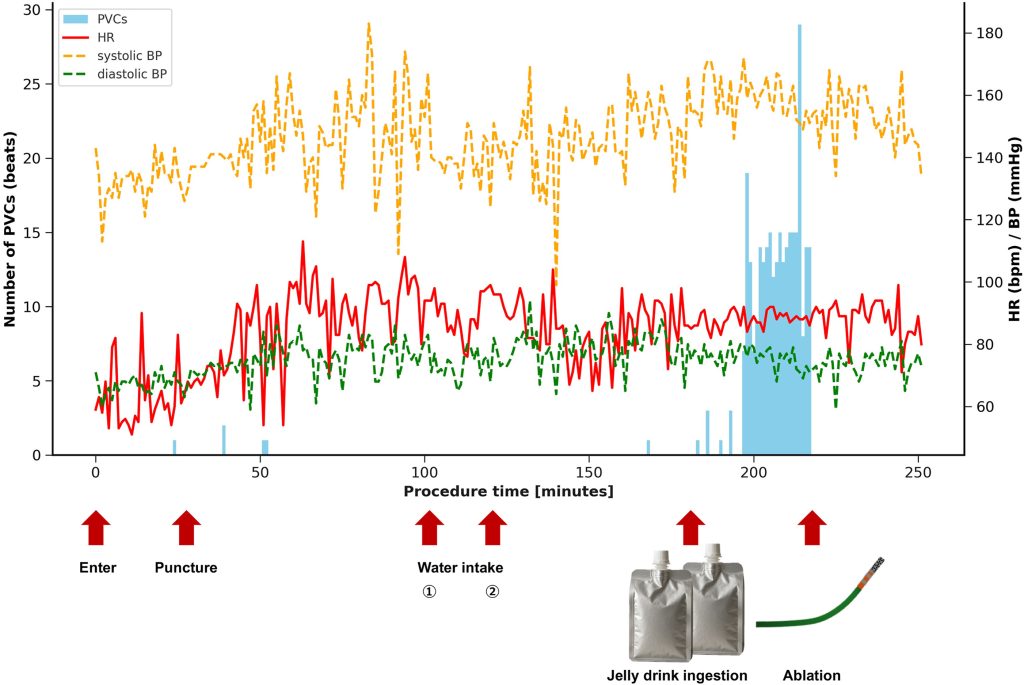
Yuta Sakaguchi, MD, PhD ∙ Satoshi Oka, MD, PhD, Kenzaburo Nakajima, MD, PhD ∙ Tsukasa Kamakura, MD, PhD ∙ Koji Miyamoto, MD, PhD ∙ Kengo Kusano, MD, PhD, FHRSTo test this, the patient drank two jelly drinks during the procedure. About 15 minutes later, her PVCs returned exactly as they did in daily life. This allowed doctors to identify the source of the abnormal heartbeats and successfully perform the ablation. Three months later, her PVCs had almost completely disappeared, and her symptoms were gone.
For people with Roemheld Syndrome, this case is particularly interesting because it suggests that stomach distension (stretching of the stomach after eating) can directly trigger heart rhythm disturbances in some individuals. It also highlights the importance of telling doctors about any connection between symptoms and meals. In certain cases, recreating those triggers during an ablation procedure may help doctors locate and treat the problem more effectively.
This is the first published case showing that meal-induced PVCs were successfully triggered during an ablation procedure and permanently treated with catheter ablation. It provides further evidence that the stomach and heart can influence each other through the body’s nervous system, a key concept behind Roemheld Syndrome.
Nota del editor
While this case report is highly interesting and provides further evidence of a connection between the digestive system and heart rhythm disturbances, it should not be viewed as a first-line treatment for people with suspected Roemheld Syndrome.
This publication describes a single patient whose PVCs were successfully treated with catheter ablation after doctors identified a meal-related trigger. Most people with Roemheld Syndrome should first focus on identifying and addressing potential gastrointestinal causes, such as excessive gas, bloating, reflux, aerophagia, or a hiatal hernia.
Nevertheless, this case is promising because it demonstrates that, in some patients, digestive triggers may play a direct role in causing abnormal heart rhythms. It also highlights the importance of discussing meal-related symptoms with your healthcare provider, particularly if your palpitations or PVCs consistently worsen after eating.
We have reached out to the authors for more information about the jelly drink mentioned in this study and are awaiting their response. In the meantime, we assume it was a commercially available nutritional jelly similar to those commonly used in Japanese hospitals and elderly care facilities. However, the article does not specify the product or its ingredients, so this remains an educated guess rather than a confirmed fact.