
No es una enfermedad del corazón, pero seguro que se siente como si lo fuera...
Síndrome de Roemheld, también conocido como Síndrome Gastrocardíaco, todavía no es un diagnóstico diferencial independiente, sino una etiqueta para un tipo específico combinación de síntomas provocados por el intestino (bloating, gas, reflux) and heart‑related sensations such as palpitations, chest discomfort or extra beats (PVC’s). Early medical writers, including Ludwig Roemheld himself (in 1912!), described the phenomenon in patients with gastrointestinal disorders, but los datos epidemiológicos modernos son casi inexistentes, and there are no large‑scale studies. Nearly all recent literature consists of individual case reports and small observational studies. Consequently, the syndrome remains descuidado y subdiagnosticado in the evaluation of arrhythmias. Our foundation aims to bring together these scattered insights so that patients and healthcare professionals can better understand this under‑recognised phenomenon
Many social-media groups, online articles and videos about Roemheld syndrome attract thousands of comments from people who are relieved to see their own mix of digestive and heart symptoms described. Such anecdotal stories aren’t scientific evidence on their own. However, when these personal reports are so numerous—and at the same time the medical literature notes that gastro‑cardiac syndrome remains a neglected and underdiagnosed factor in the work‑up of arrhythmias and that there are no reliable prevalence data because only sparse case reports exist: it suggests a potential unmet clinical need. This community deserves to be listened to and the condition warrants more systematic research and clinical awareness.
Todo lo que queda es que los pacientes convenzan a su médico y encuentren una cura. Esa es la parte difícil.
Síntomas posibles
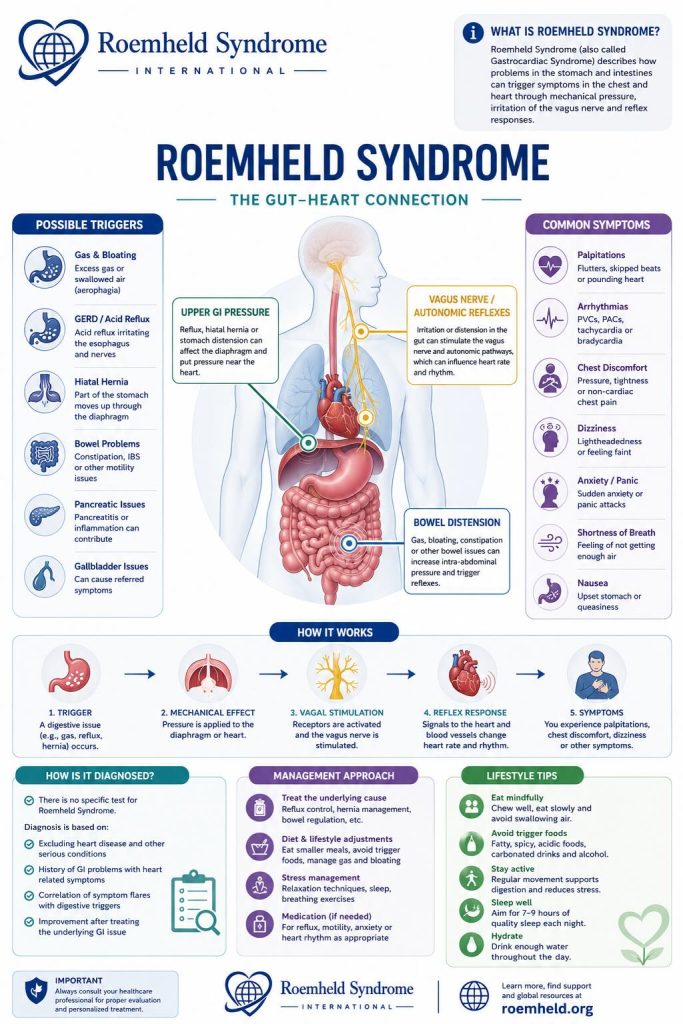
Si bien la mayoría de la gente piensa en síntomas relacionados con el corazón, en realidad hay tres áreas diferentes que deberíamos examinar: Gastrointestinal, Cardiovascular y Psicológico. Patient can have one or more symptoms in each category
Posibles Causas Gastrointestinales
Se cree que el Síndrome de Roemheld es una combinación de mecánico, neurológico, hormonal e inmunológico variables que influyen en el ritmo y la función del corazón.Basado en el artículo: Explorando el síndrome de Roemheld: una revisión integral con criterios diagnósticos propuestosHerz Magazine, 7 de mayo de 2024Autores: Muhammad Umair Javaid, Muhammad Ikrama, Shafqat Abbas, Muhammad Saad Javaid, Muhammad Danial Khalid, Nabeel Riaz, Malik Ahsan Safdar. https://doi.org/10.1007/s00059-024-05249-yNos gustaría agradecer a los autores por permitirnos citar el artículo.
Posibles tratamientos
La palabra “posible” se utiliza deliberadamente. Actualmente no existe un tratamiento único que funcione para todas las personas con sospecha de Síndrome de Roemheld.
Muchas personas experimentan síntomas significativos que pueden afectar en gran medida su calidad de vida. Es comprensible que los pacientes busquen respuestas y tratamientos efectivos. Sin embargo, el síndrome de Roemheld parece tener múltiples causas y desencadenantes posibles, lo que significa que lo que funciona bien para una persona puede tener poco o ningún efecto en otra.
Los tratamientos que se enumeran a continuación han sido reportados por pacientes, médicos e investigadores. Las experiencias varían ampliamente. Algunos pacientes describen un tratamiento como ineficaz, mientras que otros reportan una mejora drástica o incluso la resolución completa de sus síntomas.
Encontrar el tratamiento adecuado a menudo requiere paciencia, observación cuidadosa y una estrecha colaboración con un profesional de la salud. El objetivo de esta sección no es recomendar un tratamiento específico, sino proporcionar una visión general de las opciones que se han discutido en la literatura médica o que han sido informadas por pacientes que viven con el Síndrome de Roemheld.
Diagnosis
Important: Roemheld Syndrome Is Not an Official Diagnosis
Roemheld Syndrome (also known as Gastrocardiac Syndrome) is currently not recognized as a formal medical diagnosis in major classification systems such as ICD-11 or DSM-5.
Many physicians may therefore be unfamiliar with the term. Patients are often diagnosed with the individual conditions that may contribute to their symptoms, such as gastroesophageal reflux disease (GERD), hiatal hernia, gastritis, bloating, arrhythmias, anxiety, or other gastrointestinal and cardiac disorders.
For this reason, Roemheld Syndrome is generally considered a diagnosis of exclusion.
What Does “Diagnosis of Exclusion” Mean?
A diagnosis of exclusion means that potentially serious medical conditions should be investigated and ruled out before considering the possibility of Roemheld Syndrome.
Chest pain, palpitations, shortness of breath, dizziness, fainting, or irregular heartbeats should always be evaluated by a qualified healthcare professional.
Cardiac Tests Commonly Performed
Depending on the symptoms, physicians may perform one or more of the following tests:
- Electrocardiogram (ECG / EKG)
- Holter monitor (24–72 hour ECG monitoring)
- Event recorder or extended rhythm monitoring
- Exercise stress test
- Echocardiogram (heart ultrasound)
- Blood tests (including cardiac enzymes)
- Coronary CT angiography
- Cardiac MRI
- Electrophysiology studies (in selected cases)
These tests help identify or exclude underlying heart disease and cardiac rhythm disorders.
Gastrointestinal Tests Commonly Performed
Because many patients report digestive symptoms, physicians may also investigate the gastrointestinal tract.
Possible tests include:
- Upper endoscopy (gastroscopy)
- Esophageal pH monitoring
- Esophageal manometry
- Barium swallow study
- Abdominal ultrasound
- CT scan
- Gastric emptying studies
- Evaluation for hiatal hernia
- Testing for Helicobacter pylori infection
Not every patient requires every test.
Proposed Diagnostic Criteria
In 2024, researchers published a review article proposing diagnostic criteria for Roemheld Syndrome. These criteria have not been formally validated but represent one of the first attempts to create a structured diagnostic framework.
The proposed criteria include:
- Gastrointestinal symptoms
- Cardiac symptoms
- A temporal relationship between the two
- Exclusion of alternative explanations
- Improvement after treatment of the gastrointestinal condition
Further research is needed before these criteria can be considered established.
Could I Have Roemheld Syndrome?
No online article can diagnose Roemheld Syndrome.
However, the possibility may be worth discussing with your healthcare provider if:
✓ Cardiac symptoms consistently occur after eating or during periods of digestive discomfort
✓ Symptoms worsen with bloating, reflux, gastric distension, or abdominal pressure
✓ There appears to be a clear temporal relationship between digestive symptoms and cardiac symptoms
✓ Cardiac investigations are largely normal or do not fully explain the symptoms
✓ Treatment of an underlying gastrointestinal condition leads to improvement in cardiac symptoms
✓ Other potential cardiac, gastrointestinal, or medical causes have been appropriately evaluated
Nota del editor
One of the greatest challenges surrounding Roemheld Syndrome is that there is currently no single test that can confirm or exclude the condition.
As a result, patients often undergo extensive cardiac and gastrointestinal investigations before a possible connection between the two systems is considered.
While modern research has renewed interest in the concept of Gastrocardiac Syndrome, much remains unknown. Patients should be cautious of anyone claiming to diagnose Roemheld Syndrome using a single test, supplement protocol, microbiome analysis, or alternative therapy. At present, careful medical evaluation and exclusion of other conditions remain the foundation of diagnosis.