
In 2018, the following article was published in the American Journal of Emergency Medicine
Saeed M, Bhandohal JS, Visco F, Pekler G, Mushiyev S. Gastrocardiac Syndrome: A Forgotten Entity. American Journal of Emergency Medicine. 2018;36:1525.e5–1525.e7.
https://www.sciencedirect.com/science/article/abs/pii/S0735675718303656?via%3Dihub
Summary
This 2018 case report describes a 75-year-old woman who presented with recurrent episodes of dizziness and was found to have severe sinus bradycardia, with a heart rate of approximately 35 beats per minute.
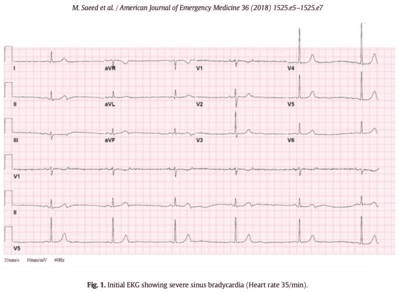
The patient had a history of hypertension, chronic obstructive pulmonary disease (COPD), dementia, and chronic constipation. Physical examination revealed a mildly distended abdomen. Laboratory investigations, cardiac enzymes, and electrolyte levels were normal, while echocardiography showed no structural heart disease or valve abnormalities.
Chest and abdominal imaging revealed significant gastric and intestinal distension, a hiatal hernia, and elevation of the left hemidiaphragm. Further evaluation did not identify a mechanical obstruction.
To relieve the distension, a nasogastric tube was inserted. Following gastric decompression, the patient’s dizziness resolved and her heart rhythm returned to normal sinus rhythm.
However, after removal of the nasogastric tube, the gastric distension returned and symptomatic bradycardia recurred. Repeat imaging confirmed recurrent gastric and colonic distension.
The authors concluded that the patient’s symptoms were caused by gastrocardiac syndrome, likely related to aerophagia and hiatal hernia. Surgical repair of the hiatal hernia was offered but declined. Because the episodes continued to recur, the patient ultimately underwent permanent pacemaker implantation, which resulted in complete resolution of her symptoms.
Why This Case Is Important
Most published reports of Roemheld Syndrome focus on palpitations, premature beats, supraventricular tachycardia, or atrial fibrillation.
This case is unusual because the primary cardiac manifestation was severe sinus bradycardia rather than a rapid heart rhythm.
The report is also important because the patient’s symptoms repeatedly improved when gastric distension was relieved and returned when the distension recurred. This pattern strengthens the argument that the gastrointestinal and cardiac symptoms were linked.
The authors noted that, to their knowledge, this was the first published case of gastrocardiac syndrome presenting as severe reversible sinus bradycardia.
Historical Perspective
One of the most interesting aspects of this paper is its discussion of the historical medical literature.
The authors reference Ludwig von Roemheld’s original descriptions from the early twentieth century and note that Roemheld believed mechanical elevation of the left diaphragm caused by gastric and intestinal gas played an important role in producing cardiac symptoms.
They also cite several largely forgotten publications from the 1930s, 1940s, and 1950s discussing what was then known as the gastrocardiac symptom complex, phrenicocardiac symptom complex, or gastrocardiac syndrome.
The paper serves as a reminder that the relationship between gastrointestinal disorders and cardiac symptoms has been discussed in the medical literature for more than a century.
Editor’s Note
This is one of the most unusual Roemheld Syndrome case reports currently available in the medical literature.
Most patients described in modern reports experience fast heart rhythms, palpitations, PVCs, or atrial fibrillation. In contrast, this patient developed profound sinus bradycardia, with a heart rate falling to approximately 35 beats per minute.
What makes the case particularly compelling is the repeated pattern observed by the treating physicians. Gastric decompression relieved both the abdominal distension and the cardiac symptoms. When the gastric distension returned, the bradycardia returned as well.
Unlike some reports where improvement occurs weeks or months after treatment, the relationship in this case was observed repeatedly during the same hospital admission.
The report also highlights an important lesson: Roemheld Syndrome may present with a much broader range of cardiac symptoms than many clinicians realize. While palpitations and tachycardia are the most commonly reported manifestations, severe bradycardia may also occur in susceptible individuals.
As with all case reports, no conclusions can be drawn from a single patient. Nevertheless, this publication adds another piece to the growing body of evidence suggesting that significant gastrointestinal distension can influence cardiac rhythm in certain circumstances.