
In October 2024, the following article was published in Hearts Journal (MDPI)
Khimani, F.; Kulkarni, C.; Haase, E.; Moore, P.; Murdock, P.; Ramanathan, A.; Wolf, A.; Sathyamoorthy, M. The Association of High Burden Premature Ventricular Contractions with Esophageal/Upper GI Diseases. Hearts 2024, 5, 516-528
https://doi.org/10.3390/hearts5040038
Summary
Premature Ventricular Contractions (PVCs) are among the most common cardiac rhythm disturbances. While occasional PVCs are often considered benign, a high PVC burden can cause significant symptoms, including palpitations, skipped beats, dizziness, fatigue, anxiety, reduced exercise tolerance, and in some cases even PVC-induced cardiomyopathy.
In this 2024 case series, researchers investigated six patients with a high burden of PVCs who also suffered from significant upper gastrointestinal disorders. The patients had conditions including:
- Hiatal hernia
- Gastroesophageal reflux disease (GERD)
- Achalasia
- Esophageal stenosis (narrowing)
- Gastric lap-band complications
All six patients had undergone extensive cardiac investigations. Despite ongoing treatment and monitoring, their PVC burden remained substantial. The authors noted that many of the patients reported a temporal relationship between their gastrointestinal symptoms and cardiac symptoms.
Rather than focusing solely on the heart, treatment was directed toward the underlying gastrointestinal disorder.
Treatment and Outcomes
The interventions varied depending on the patient’s diagnosis and included:
- Hiatal hernia repair
- LINX magnetic sphincter augmentation for reflux disease
- Esophageal dilation for achalasia or esophageal narrowing
- Removal of a gastric lap-band
- Other targeted upper GI interventions
Following treatment, the authors observed a marked reduction in PVC burden in all six patients.
Across the study population, PVC frequency decreased by an average of approximately 68%.
Some improvements were particularly striking.
One patient with a PVC burden of 26% before hiatal hernia repair experienced a reduction to less than 0.01% following surgery. Another patient saw PVC burden decrease from 14.6% to 0.1% after treatment. Several patients also reported substantial improvement in palpitations and overall quality of life.
Although the study was small, the consistency of improvement across all six cases caught the authors’ attention.
What Might Explain the Connection?
The study does not prove exactly why these improvements occurred, but the authors discuss several possible explanations.
Vagus Nerve Stimulation
The vagus nerve provides an important communication pathway between the digestive system and the heart.
Reflux, esophageal distension, hiatal hernia, and other upper GI disorders may stimulate vagal pathways and influence cardiac electrical activity. This mechanism has long been proposed as one possible explanation for gastrocardiac symptoms.
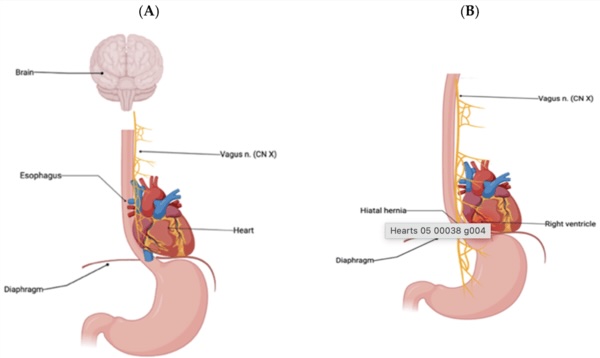
Mechanical Effects
The authors also suggest that enlarged or diseased structures in the upper gastrointestinal tract may physically affect nearby cardiac structures.
Particular attention was given to the right ventricular outflow tract (RVOT), a common origin site for PVCs. Interestingly, all six patients appeared to have PVCs arising from this region.
The researchers speculate that chronic mechanical irritation, inflammation, or pressure from nearby gastrointestinal structures may contribute to arrhythmia generation in susceptible individuals.
Inflammation and Autonomic Dysfunction
The paper also discusses the possibility that chronic inflammation, autonomic nervous system imbalance, and altered signaling between the gut and heart may play a role.
These mechanisms remain theoretical but are increasingly being explored in modern gut–heart research.
The Concept of “E-PVCs”
One of the more interesting proposals in the paper is the introduction of the term “E-PVCs”, short for Esophageal Premature Ventricular Contractions.
The authors suggest that a subset of PVCs may be triggered or amplified by pathology in the esophagus or upper gastrointestinal tract.
At present, E-PVCs are not a formally recognized medical diagnosis. The term is proposed as a research concept intended to stimulate further investigation into patients whose ventricular ectopy appears closely linked to upper GI disease.
If future studies confirm these observations, E-PVCs could represent a distinct subgroup of PVC patients who may benefit from evaluation and treatment of underlying gastrointestinal disorders.
What Are the Limitations?
This study involved only six patients and therefore cannot establish causation.
Several important limitations should be considered:
- Small sample size
- No control group
- Potential selection bias
- Natural fluctuations in PVC burden may occur
- Findings may not apply to all PVC patients
The authors themselves emphasize that larger prospective studies are needed before firm conclusions can be drawn.
Why Is This Relevant to Roemheld Syndrome?
For more than a century, patients have reported episodes of palpitations, skipped beats, rapid heart rate, chest discomfort, and other cardiac symptoms that seem closely linked to digestive problems.
Historically, many discussions surrounding Roemheld Syndrome have focused on palpitations, tachycardia, anxiety, reflux, bloating, and vagal stimulation. Modern research examining ventricular arrhythmias such as PVCs in this context has been relatively limited.
This study is therefore noteworthy because it specifically explores the possibility that upper gastrointestinal pathology may contribute to ventricular arrhythmias in some individuals.
While the findings do not prove the existence of a distinct gastrocardiac PVC syndrome, they provide modern clinical observations that support further investigation into the gut–heart connection first described by Ludwig Roemheld more than a century ago.
Editor’s Note
This paper is one of the most interesting recent publications for patients and clinicians interested in the relationship between gastrointestinal disorders and cardiac rhythm disturbances.
What makes the study particularly noteworthy is that it goes beyond anecdotal reports. The authors documented objective reductions in PVC burden on cardiac monitoring after treatment of significant upper GI disorders. In several cases, the improvements were dramatic.
At the same time, readers should remain cautious. Six patients are not enough to establish cause and effect, and the proposed mechanisms—including vagal stimulation, mechanical pressure, and the concept of “E-PVCs”—remain hypotheses rather than proven facts.
Nevertheless, the study raises an important question: could some patients with otherwise unexplained high-burden PVCs benefit from a more thorough evaluation of the esophagus, stomach, diaphragm, and upper gastrointestinal tract?
The answer is not yet known. However, studies such as this help move the discussion from patient anecdotes toward objective clinical research.
As always, new or worsening palpitations, skipped beats, dizziness, chest pain, or other cardiac symptoms should be evaluated by a qualified healthcare professional.