
In 2017, the following article was published in Europace Journal (European Society of Cardiology)
Linz D, Hohl M, Vollmar J, Ukena C, Mahfoud F, Böhm M. Atrial fibrillation and gastroesophageal reflux disease: The cardiogastric interaction. Europace. 2017;19(1):16–20.
https://doi.org/10.1093/europace/euw092
Summary
In this review article, cardiologists and electrophysiologists examine the possible relationship between gastroesophageal reflux disease (GERD) and atrial fibrillation (AF), the most common sustained cardiac arrhythmia.
The authors note that the esophagus and the left atrium are located in very close anatomical proximity, separated by only a few millimeters in some individuals. Because of this relationship, inflammation, mechanical irritation, and autonomic nervous system reflexes originating in the esophagus may potentially influence cardiac rhythm.
The review discusses several studies that found an increased prevalence of atrial fibrillation in patients with GERD. Some studies suggested that GERD may increase the risk of developing AF, particularly in patients with evidence of esophageal inflammation (esophagitis). However, the authors also acknowledge that not all studies have found the same association.
Several possible mechanisms are explored:
Autonomic Nervous System Effects
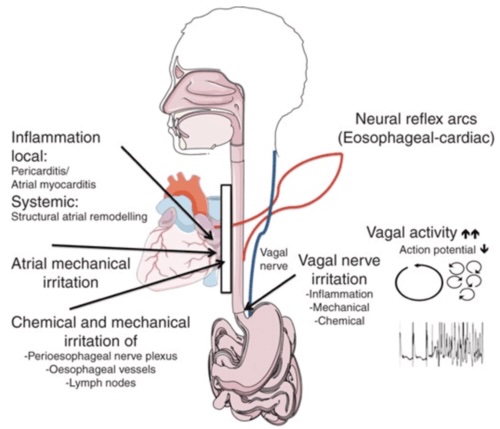
The esophagus and heart are connected through complex neural pathways involving the vagus nerve and autonomic nervous system.
The authors describe how acid reflux and esophageal irritation may alter the balance between sympathetic and parasympathetic activity. Increased vagal stimulation has long been recognized as a potential trigger for certain cardiac arrhythmias, including atrial fibrillation.
Inflammation
GERD may cause local inflammation of the esophagus. Because the esophagus lies directly behind the left atrium, inflammatory processes could potentially affect nearby cardiac structures or influence arrhythmia susceptibility through inflammatory mediators.
Mechanical Effects
The review discusses the possibility that large hiatal hernias or intrathoracic stomachs may mechanically irritate the left atrium. The authors cite case reports in which surgical repair of large hiatal hernias was associated with improvement or disappearance of atrial arrhythmias.
Triggered Arrhythmias
The authors note reports of atrial fibrillation episodes triggered by gastrointestinal events such as:
- Abdominal bloating
- Defecation
- Alcohol consumption
- Cold drinks
- Fatty meals
These observations suggest that, in some individuals, gastrointestinal stimulation may contribute to arrhythmia initiation.
Proton Pump Inhibitor (PPI) Therapy
Several small studies reviewed by the authors found that treatment of GERD with proton pump inhibitors (PPIs) reduced atrial fibrillation symptoms or arrhythmia burden in some patients.
However, the available studies were small, and the authors stress that larger prospective trials are needed before any firm conclusions can be drawn.
Conclusions of the Authors
The authors conclude that a cardiogastric interaction between GERD and atrial fibrillation appears biologically plausible and is supported by several clinical observations. However, they emphasize that the evidence remains incomplete and that further research is required to establish whether GERD directly contributes to AF development and whether treatment of reflux can reliably reduce arrhythmia burden.
Editor’s Note
This review is particularly important because it comes from the field of cardiology rather than alternative medicine or patient advocacy. The authors do not attempt to prove the existence of Roemheld Syndrome, nor do they dismiss it. Instead, they carefully examine possible mechanisms that could explain why gastrointestinal disorders and cardiac arrhythmias sometimes occur together.
Of particular interest is the article’s acknowledgment that Ludwig Roemheld’s original observations may have a physiological basis involving autonomic nervous system reflexes, inflammation, and mechanical interactions between the esophagus, stomach, and heart.
Importantly, the authors repeatedly caution that association does not prove causation. While some patients appear to experience improvement in arrhythmias after treatment of reflux disease or hiatal hernia, larger studies are still needed before definitive conclusions can be reached.
For readers interested in the scientific foundations of Roemheld Syndrome, this article represents one of the most balanced and evidence-based discussions currently available.