
On May 7 2024, the following article was published:
Exploring Roemheld syndrome: a comprehensive review with proposed diagnostic criteria,Herz Magazine, 7 May 2024Authors: Muhammad Umair Javaid, Muhammad Ikrama, Shafqat Abbas, Muhammad Saad Javaid, Muhammad Danial Khalid, Nabeel Riaz, Malik Ahsan Safdar. https://doi.org/10.1007/s00059-024-05249-yWe'd like to thank the authors for allowing us to cite from the article.
Diagnosis
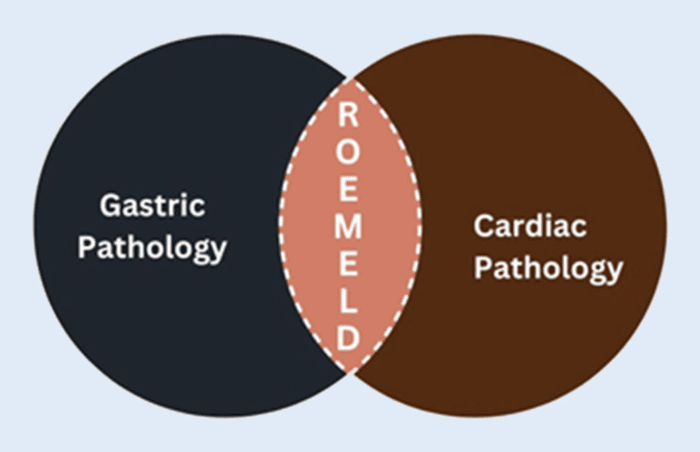
Instead of being a specific diagnosis, Roemheld syndrome is a collection of symptoms that could have a variety of underlying causes and mechanisms. Roemheld syndrome is diagnosed based on a patient’s medical history, physical examination, and elimination of other cardiac and gastrointestinal problems; there are no particular tests or criteria for the diagnosis. As previously mentioned, various more prevalent and life-threatening medical conditions such as angina, myocardial infarction, pericarditis, pulmonary embolism, aortic dissection, or esophageal spasm can easily be mistaken for Roemheld syndrome. This may result in pointless tests, procedures, or patient problems.
Muhammad Umair Javaid, Muhammad Ikrama, Shafqat Abbas, Muhammad Saad Javaid, Muhammad Danial Khalid, Nabeel Riaz, Malik AhsanWe suggest that the following criteria are highly suitable for the diagnosis of Roemheld syndrome and we invite academics to critically evaluate and possibly modify these criteria. We have called this list the IKMAIR criteria.
I. At least one of the following cardiac symptoms must be present: dyspnea, syncope, palpitations, chest discomfort, or arrhythmias.
II. At least one gastrointestinal symptom, such as nausea, vomiting, bloating, stomach discomfort, or excessive gas, must be present.
III. There must be a temporal relationship between the cardiac and gastrointestinal symptoms, whereby the gastrointestinal symptoms cause or exacerbate the cardiac symptoms.
IV. Relieving the gastrointestinal symptoms, such as belching, passing gas, adjusting posture, or taking antacids, can relieve the cardiac symptoms.
V. There are no anatomical or functional issues with the heart that could account for the symptoms of cardiac disease.
VI. There is a lack of any psychiatric or psychological conditions that could account for the heart symptoms.
Scoring
To determine the likelihood of Roemheld syndrome, the scores are summed:
Total score 0–6:
4–6: High likelihood of Roemheld syndrome
2–3: Moderate likelihood; further evaluation may be needed
0–1: Low likelihood of Roemheld syndrome
Editor’s Note
The IKMAIR Criteria are a proposed scoring system introduced by the authors of this review article. They have not yet been independently validated and should be viewed as a research proposal rather than an officially accepted diagnostic standard. Nevertheless, they provide a useful framework for understanding the key features commonly associated with Roemheld Syndrome.
The abbreviation IKMAIR does not refer to a medical condition, test, or established medical term. The authors do not explain the origin of the name in the article, but it appears to be derived from the names of the researchers who proposed the criteria.