
What is Roemheld syndrome? Symptoms, Causes, Treatment

It’s not a heart disease, but it sure feels like it is…

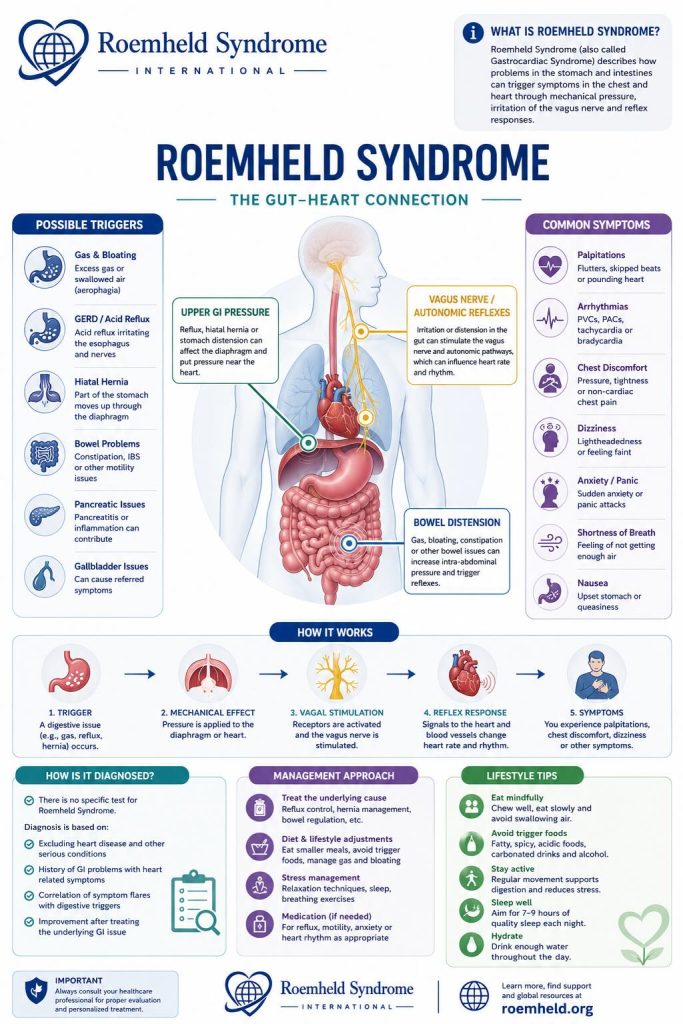
Roemheld syndrome, also known as Gastro-Cardiac Syndrome, isn’t a standalone differential diagnosis (yet), but a label for a specific combination of gut‑driven symptoms (bloating, gas, reflux) and heart‑related sensations such as palpitations, chest discomfort or extra beats (PVC’s). Early medical writers, including Ludwig Roemheld himself (in 1912!), described the phenomenon in patients with gastrointestinal disorders, but modern epidemiological data are almost non‑existent, and there are no large‑scale studies. Nearly all recent literature consists of individual case reports and small observational studies. Consequently, the syndrome remains neglected and underdiagnosed in the evaluation of arrhythmias. Our foundation aims to bring together these scattered insights so that patients and healthcare professionals can better understand this under‑recognised phenomenon

Many social-media groups, online articles and videos about Roemheld syndrome attract thousands of comments from people who are relieved to see their own mix of digestive and heart symptoms described. Such anecdotal stories aren’t scientific evidence on their own. However, when these personal reports are so numerous—and at the same time the medical literature notes that gastro‑cardiac syndrome remains a neglected and underdiagnosed factor in the work‑up of arrhythmias and that there are no reliable prevalence data because only sparse case reports exist: it suggests a potential unmet clinical need. This community deserves to be listened to and the condition warrants more systematic research and clinical awareness.

All that’s left is for the patients is to convince their doctor, and to find a cure. That’s the hard part.

Possible Symptoms

While most people think of heart-related symptoms, there are actually three different ares we should examine: Gastrointestinal, Cardiovascular and Psychological. Patient can have one or more symptoms in each category

Indigestion, heartburn, nausea, bloating, belching, constipation, diarrhea, flatulence.

Dyspnea (shortness of breath), blood‑pressure changes, chest pain, palpitations, PVCs, PACs, Atrial fibrillation, Tachycardia, Bradycardia, Sinus pauses, Swallowing-induced arrhythmias, Sinus pauses associated with epigastric burning, have all been described in modern gastro-cardiology literature.

Panic attacks, anxiety, stress, sadness, phobias.

Possible Gastrointestinal Causes


The Roemheld Syndrome is thought to be a combination of mechanical, neurological, hormonal, and immunological variables that influence the heart’s rhythm and function.

Based on the article: Exploring Roemheld syndrome: a comprehensive review with proposed diagnostic criteria
Herz Magazine, 7 May 2024
Authors: Muhammad Umair Javaid, Muhammad Ikrama, Shafqat Abbas, Muhammad Saad Javaid, Muhammad Danial Khalid, Nabeel Riaz, Malik Ahsan Safdar. https://doi.org/10.1007/s00059-024-05249-y
We'd like to thank the authors for allowing us to cite from the article.

GERD occurs when stomach acid chronically flows back into the oesophagus, causing inflammation and damage. Symptoms include heartburn, regurgitation, nausea, bloating and difficulty swallowing. GERD can increase the risk of Barrett’s oesophagus and may trigger vasospastic angina via a shared symptom profile or the effect of calcium‑channel blockers. In Roemheld syndrome, the irritation and gas production associated with GERD can distend the stomach, press on the diaphragm and stimulate vagal nerves, provoking cardiac sensations.

A hiatal hernia occurs when part of the stomach pushes upward through the diaphragm into the chest cavity.  This creates a “pocket” of gas and impairs the lower oesophageal sphincter, leading to heartburn, chest pain, belching and swallowing difficulty. The herniated stomach can mechanically compress the heart or stimulate the vagus nerve, which is why hiatal hernia is one of the most commonly reported anatomical triggers of Roemheld syndrome.

The gallbladder stores and secretes bile; if its function or blood supply is impaired, it can lead to abdominal discomfort, nausea, vomiting, fever and jaundice. Poor gallbladder function can also promote gallstone formation. Gallstones may obstruct the flow of bile, inflame the pancreas or gallbladder and disturb digestion, causing distension and vagal stimulation that contribute to Roemheld symptoms.

Lactose intolerance: A lack of the lactase enzyme means lactose isn’t digested; dairy products ferment in the gut, causing nausea, diarrhoea, gas, bloating and stomach pain.

Sphincter of Oddi dysfunction: When this valve fails to open or close properly, it disrupts the flow of bile and pancreatic juices, leading to abdominal pain, fever, jaundice and sometimes pancreatitis.

Aneructonia (inability to burp): Damage to the phrenic nerve or upper oesophageal sphincter prevents belching, so gas accumulates and puts pressure on the heart and diaphragm; it is often linked to anxiety or stress.

Intestinal obstruction: Bowel obstruction causes dehydration, electrolyte imbalances and infection, and the resulting distension can impair heart rhythm and function.

Acute pancreatic necrosis: When pancreatic enzymes leak into the abdomen, they trigger intense pain and inflammation; the release of cytokines and toxins can damage the heart muscle and lead to arrhythmias.

Possible Treatments

The word “possible” is used deliberately. There is currently no single treatment that works for everyone with suspected Roemheld Syndrome.

Many people experience significant symptoms that can greatly affect their quality of life. It is understandable that patients are searching for answers and effective treatments. However, Roemheld Syndrome appears to have multiple possible causes and triggers, meaning that what works well for one person may have little or no effect for another.

The treatments listed below have been reported by patients, physicians, and researchers. Experiences vary widely. Some patients describe a treatment as ineffective, while others report dramatic improvement or even complete resolution of their symptoms.

Finding the right treatment often requires patience, careful observation, and close collaboration with a healthcare professional. The goal of this section is not to recommend a specific treatment, but to provide an overview of options that have been discussed in the medical literature or reported by patients living with Roemheld Syndrome.

Maagzuurremmers
Antacids are medicines that neutralize stomach acid and can provide quick, short-term relief from heartburn, indigestion, reflux, or bloating-related discomfort. They usually work faster than PPIs, but their effect is shorter.
Tums, Rolaids, Alka-Seltzer, Mylanta, Maalox, Pepto-Bismol, Gaviscon, Rennie, Bisodol, Acidex, Eno, Milk of Magnesia, Quick-Eze, Gelusil, Digene, Di-Gel, Amphojel, Alu-Tab.
Availability and brand names depends on where you live. They all have different ingredients, but usually are a mix of Calcium Carbonate, Magnesium Hydroxide and Sodium Bicarbonate.


PPI’s
PPIs, or proton pump inhibitors, are medicines that reduce the amount of acid your stomach produces. They are commonly used for reflux, heartburn, gastritis, ulcers, and hiatal hernia-related symptoms. They do not give immediate relief like antacids, but usually work better when taken consistently over several days.
Prilosec / Losec — omeprazole, Nexium — esomeprazole, Prevacid / Zoton — lansoprazole, Protonix / Pantoloc / Somac / Controloc — pantoprazole, AcipHex / Pariet — rabeprazole, Dexilant — dexlansoprazole, Zegerid — omeprazole + sodium bicarbonate.
Availability and brand names depends on where you live.

Bètablokkers
Beta-blockers are medicines that slow the heart rate and reduce the effect of adrenaline on the heart. They are sometimes prescribed for palpitations, PVCs, PACs, fast heart rhythm, high blood pressure, or anxiety-related physical symptoms. In suspected Roemheld Syndrome, they may help reduce the heart symptoms, but they do not treat the underlying digestive trigger itself. They should only be used under medical supervision, especially in people with low heart rate, low blood pressure, asthma/COPD, or certain heart conduction problems.
Metoprolol (Lopressor, Toprol-XL, Betaloc), Bisoprolol (Zebeta, Cardicor, Emcor), Atenolol (Tenormin), Propranolol (Inderal), Nebivolol (Bystolic, Nebilet), Carvedilol (Coreg, Dilatrend). Yes, most beta-blockers end with the "olol" or "lol". Nothing funny about that, right?
Availability and brand names depends on where you live.

Anti-Gas Medication
Simethicone is a medication used to reduce excess gas in the stomach and intestines. It works by breaking up small gas bubbles into larger ones, making them easier to pass through belching or flatulence. Unlike antacids or PPIs, simethicone does not reduce stomach acid and is not absorbed into the bloodstream.

Many people with suspected Roemheld Syndrome report that gas, bloating, and stomach distension are major triggers for their symptoms. Excess gas may increase pressure within the abdomen, potentially affecting the diaphragm and surrounding structures. Some researchers have also suggested a possible role for vagal reflexes, although the exact mechanisms remain under investigation.

Because simethicone is generally considered safe and has few side effects, it is often one of the first treatments patients try when bloating and gas appear to be contributing factors.
Gas-X, Phazyme, Mylicon, Rennie Deflatine, Wind-Eze.
Availability and brand names depends on where you live.
The key ingredient is Simethicone.

Prokinetics
These are medications that help the stomach and intestines move food along more effectively. For Roemheld-type symptoms, they may be relevant when symptoms are linked to slow stomach emptying, fullness after meals, bloating, reflux, nausea, or pressure under the chest.
Prokinetics primarily target the enteric nervous system (the nervous system of the gut) and smooth muscles to stimulate peristalsis; the involuntary wave-like muscle contractions that push food along.
Domperidone, Metoclopramide, Itopride, Prucalopride
Availability and brand names depend on where you live. These medications contain different active ingredients, including domperidone, metoclopramide, itopride, and prucalopride.

Anti-Anxiety Medications
For many patients with suspected Roemheld Syndrome, the problem is not simply “in the head.” Physical symptoms such as bloating, chest pressure, palpitations, skipped beats, shortness of breath, and dizziness can be very real and very frightening.

However, anxiety can still play an important role. When the body senses unusual heartbeats or chest discomfort, it can trigger a stress response. This may increase adrenaline, raise awareness of every heartbeat, tighten breathing patterns, and make symptoms feel even stronger. In this way, anxiety can become part of the symptom cycle, even when it was not the original cause.

In some patients, anti-anxiety medication may help reduce this cycle and make symptoms easier to manage. These medications do not “prove” that the symptoms are psychological. They may simply help calm the nervous system while the underlying digestive or cardiac triggers are being investigated and treated.

Examples include benzodiazepines such as diazepam, lorazepam, and alprazolam, and longer-term medications such as SSRIs or SNRIs. These should only be used under medical supervision. Some anti-anxiety medications can cause drowsiness, dependence, withdrawal symptoms, or interactions with other medicines, so they should not be started, stopped, or changed without medical advice.
Benzodiazepines: Valium — diazepam, Ativan / Temesta — lorazepam, Xanax / Xanor — alprazolam, Seresta / Serax — oxazepam, Klonopin / Rivotril — clonazepam.
SSRIs: Lexapro / Cipralex — escitalopram, Zoloft / Lustral — sertraline, Paxil / Seroxat — paroxetine, Prozac — fluoxetine, Luvox — fluvoxamine, Celexa / Cipramil — citalopram.

Supplementen ⚠️
Magnesium, potassium, probiotics, digestive enzymes, omega-3 fatty acids, vitamin D.

⚠️ Editor’s Note
Some supplements may be helpful in addressing nutritional deficiencies or supporting general health. However, no supplement has been proven to treat Roemheld Syndrome itself.

Roemheld Syndrome is an understudied condition, and while some patients report benefit from certain supplements, these observations do not establish effectiveness. Personal experiences can be valuable, but they should not be confused with scientific proof.

We do not endorse any supplement, manufacturer, brand, retailer, practitioner, clinic, or commercial product. Patients should be cautious of exaggerated health claims, expensive treatment programs, or recommendations that rely primarily on testimonials rather than published evidence.

Always discuss supplements and dietary changes with your healthcare provider, particularly if you have a history of heart disease or take prescription medications.

🚩 Important
The treatments listed here are medications and therapies that have been used to manage symptoms reported by some patients with suspected Roemheld Syndrome. Their inclusion on this page does not imply that they are proven treatments for Roemheld Syndrome itself. Always consult a qualified healthcare professional before starting, stopping, or changing any medication.

Lifestyle & Dietary Measures

Lifestyle changes are often among the first approaches considered by people with suspected Roemheld Syndrome. While no single strategy works for everyone, some patients report significant improvements by identifying and reducing triggers that contribute to bloating, reflux, stomach distension, or excessive pressure on the diaphragm.

Smaller, More Frequent Meals
Large meals can increase stomach distension and may trigger symptoms in susceptible individuals. Some patients find that eating smaller meals more frequently reduces discomfort.

Eat Slowly
Eating too quickly can increase the amount of air swallowed and may worsen bloating and gas.

Reduce Aerophagia (Air Swallowing)
Aerophagia is the excessive swallowing of air. It may occur when eating quickly, talking while eating, chewing gum, smoking, drinking through straws, or breathing through the mouth.

Avoid Carbonated Beverages
Carbonated drinks introduce additional gas into the digestive system and may worsen bloating, belching, and pressure-related symptoms.

Identify Trigger Foods
Commonly reported triggers include fatty meals, spicy foods, onions, garlic, beans, cabbage, broccoli, alcohol, and highly processed foods. Triggers vary significantly between individuals.

Manage Constipation
Constipation can increase abdominal pressure and contribute to bloating and discomfort. Addressing constipation may reduce symptoms in some patients.

Stay Upright After Meals
Some people report worsening symptoms when lying down immediately after eating. Remaining upright for a period after meals may help reduce reflux and stomach pressure.

Weight Management
In overweight individuals, weight loss may reduce abdominal pressure and improve symptoms associated with reflux and hiatal hernia.

Sleep Position
Some patients find that sleeping on their left side or elevating the head of the bed helps reduce nighttime reflux and associated symptoms.

Stress Reduction and Relaxation Techniques
Although Roemheld Syndrome is not considered a psychological disorder, stress and anxiety can amplify physical symptoms. Relaxation techniques, breathing exercises, meditation, and gentle physical activity may help break the cycle of symptoms and anxiety.

Redactionele Opmerking: Lifestyle and dietary changes are generally low-risk and are often among the first measures patients explore. However, no lifestyle intervention has been proven to cure Roemheld Syndrome, and results vary considerably from person to person. What works well for one individual may have little effect for another.

Hiatal Hernia Repair
A number of published case reports describe patients experiencing significant improvement or complete resolution of gastro-cardiac symptoms after surgical repair of a hiatal hernia. This is particularly relevant for patients whose symptoms appear closely linked to a diagnosed hiatal hernia.

Fundoplication
Fundoplication is a surgical procedure used to treat severe reflux (GERD). The upper part of the stomach is wrapped around the lower esophagus to strengthen the valve that prevents acid reflux. Some patients report improvement in both digestive and cardiac-like symptoms.

LINX Procedure
The LINX system is a ring of magnetic beads placed around the lower esophagus to help prevent reflux while allowing normal swallowing. It is a less invasive alternative to fundoplication for selected patients.

PVC Ablation
In some patients, frequent PVCs become a major source of symptoms. Catheter ablation is a procedure that identifies and destroys the small area of heart tissue responsible for the abnormal electrical activity.

Vagotomy (Historical / Rare)
Vagotomy involves cutting part of the vagus nerve and has occasionally been discussed in historical literature related to gastro-cardiac symptoms. It is rarely performed today for this purpose and is generally not considered a standard treatment for Roemheld Syndrome.

🚩 Important
These procedures are not treatments for Roemheld Syndrome itself, but several published case reports describe improvement or resolution of cardiac symptoms following correction of underlying gastrointestinal pathology.


Diagnosis


Important: Roemheld Syndrome Is Not an Official Diagnosis

Roemheld Syndrome (also known as Gastrocardiac Syndrome) is currently not recognized as a formal medical diagnosis in major classification systems such as ICD-11 or DSM-5.

Many physicians may therefore be unfamiliar with the term. Patients are often diagnosed with the individual conditions that may contribute to their symptoms, such as gastroesophageal reflux disease (GERD), hiatal hernia, gastritis, bloating, arrhythmias, anxiety, or other gastrointestinal and cardiac disorders.

For this reason, Roemheld Syndrome is generally considered a diagnosis of exclusion.


What Does “Diagnosis of Exclusion” Mean?

A diagnosis of exclusion means that potentially serious medical conditions should be investigated and ruled out before considering the possibility of Roemheld Syndrome.

Chest pain, palpitations, shortness of breath, dizziness, fainting, or irregular heartbeats should always be evaluated by a qualified healthcare professional.


Cardiac Tests Commonly Performed

Depending on the symptoms, physicians may perform one or more of the following tests:

  • Electrocardiogram (ECG / EKG)
  • Holter monitor (24–72 hour ECG monitoring)
  • Event recorder or extended rhythm monitoring
  • Exercise stress test
  • Echocardiogram (heart ultrasound)
  • Blood tests (including cardiac enzymes)
  • Coronary CT angiography
  • Cardiac MRI
  • Electrophysiology studies (in selected cases)

These tests help identify or exclude underlying heart disease and cardiac rhythm disorders.


Gastrointestinal Tests Commonly Performed

Because many patients report digestive symptoms, physicians may also investigate the gastrointestinal tract.

Possible tests include:

  • Upper endoscopy (gastroscopy)
  • Esophageal pH monitoring
  • Esophageal manometry
  • Barium swallow study
  • Abdominal ultrasound
  • CT scan
  • Gastric emptying studies
  • Evaluation for hiatal hernia
  • Testing for Helicobacter pylori infection

Not every patient requires every test.


Proposed Diagnostic Criteria

In 2024, researchers published a review article proposing diagnostic criteria for Roemheld Syndrome. These criteria have not been formally validated but represent one of the first attempts to create a structured diagnostic framework.

The proposed criteria include:

  • Gastrointestinal symptoms
  • Cardiac symptoms
  • A temporal relationship between the two
  • Exclusion of alternative explanations
  • Improvement after treatment of the gastrointestinal condition

Further research is needed before these criteria can be considered established.


Could I Have Roemheld Syndrome?

No online article can diagnose Roemheld Syndrome.

However, the possibility may be worth discussing with your healthcare provider if:

✓ Cardiac symptoms consistently occur after eating or during periods of digestive discomfort

✓ Symptoms worsen with bloating, reflux, gastric distension, or abdominal pressure

✓ There appears to be a clear temporal relationship between digestive symptoms and cardiac symptoms

✓ Cardiac investigations are largely normal or do not fully explain the symptoms

✓ Treatment of an underlying gastrointestinal condition leads to improvement in cardiac symptoms

✓ Other potential cardiac, gastrointestinal, or medical causes have been appropriately evaluated


Editor’s Note

One of the greatest challenges surrounding Roemheld Syndrome is that there is currently no single test that can confirm or exclude the condition.

As a result, patients often undergo extensive cardiac and gastrointestinal investigations before a possible connection between the two systems is considered.

While modern research has renewed interest in the concept of Gastrocardiac Syndrome, much remains unknown. Patients should be cautious of anyone claiming to diagnose Roemheld Syndrome using a single test, supplement protocol, microbiome analysis, or alternative therapy. At present, careful medical evaluation and exclusion of other conditions remain the foundation of diagnosis.