
In August 2021, the following article was published in Cardiovasc Surgery International (Turkish Society of Cardiovascular Surgery)
Bodur O, Yılmaz AS, Akdoğan R, Durakoğlugil ME, Duman H, Kocaman SA, Çetin M. Esophagitis and gastritis are associated with premature atrial contractions in patients with gastroesophageal reflux disease. Cardiovascular Surgery and Interventions. 2021;8(2):109–115. doi:10.5606/e-cvsi.2021.1115.
Link to article
Summary
In this 2021 study, Turkish researchers investigated whether inflammation of the esophagus (esophagitis) and stomach (gastritis) is associated with premature atrial contractions (PACs) in patients with symptoms of gastroesophageal reflux disease (GERD).
Premature atrial contractions are early heartbeats originating in the upper chambers of the heart. Although often considered benign, PACs have attracted increasing attention because they may contribute to the development of atrial fibrillation and other atrial arrhythmias.
The study included 108 patients who underwent gastroduodenal endoscopy for symptoms of GERD such as heartburn and regurgitation. All patients also underwent 24-hour Holter monitoring to detect cardiac rhythm abnormalities.
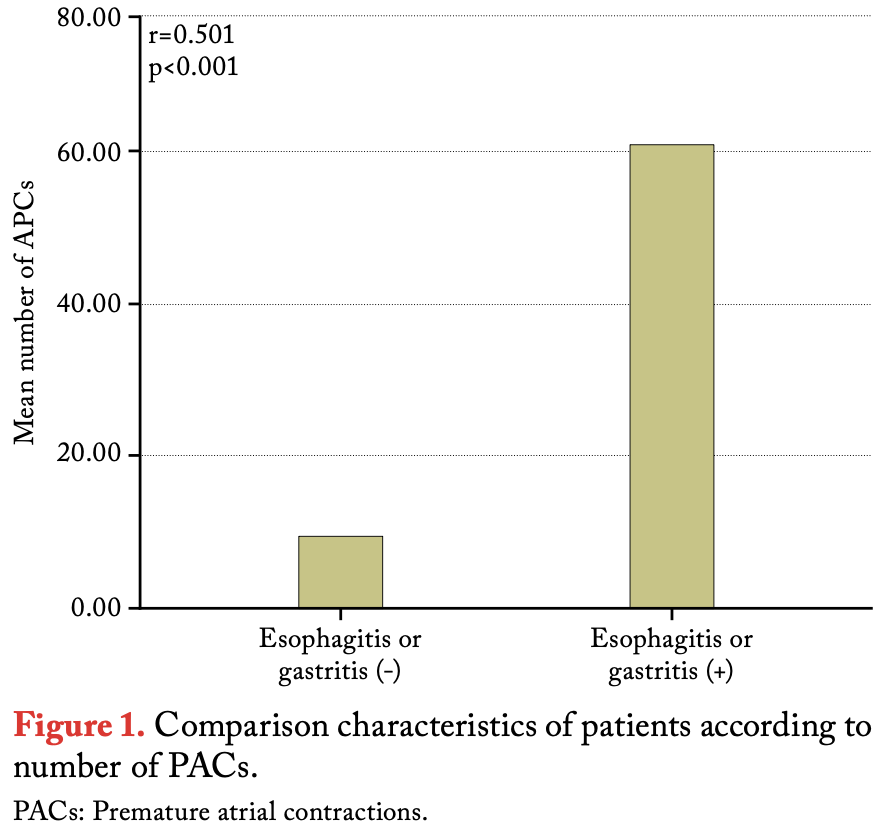
Of the 108 patients:
- 80 patients had endoscopic evidence of esophagitis and/or erosive gastritis.
- 28 patients had reflux symptoms without visible inflammatory changes.
The researchers found a striking relationship between gastrointestinal inflammation and cardiac rhythm disturbances.
Patients with premature atrial contractions were significantly more likely to have esophagitis and/or erosive gastritis than patients without PACs. In fact, 94.5% of patients with PACs had evidence of esophagitis and/or gastritis, compared with only 30.6% of patients without PACs.
The total number of PACs recorded during Holter monitoring was also substantially higher in patients with esophagitis and/or gastritis.
After adjusting for other factors, the presence of esophagitis and/or gastritis remained an independent predictor of PACs.
The authors discuss several possible explanations for this relationship.
Vagal Nerve Stimulation
The esophagus and stomach contain numerous vagal nerve endings. Inflammation and acid exposure may stimulate these nerves, potentially affecting the autonomic nervous system and increasing susceptibility to atrial arrhythmias.
Inflammation
Chronic inflammation associated with esophagitis and gastritis results in the release of inflammatory cytokines. Previous research has suggested that inflammation may contribute to the development of atrial fibrillation and other cardiac rhythm disturbances.
Anatomical Proximity
The esophagus lies directly behind the left atrium, separated by only a few millimeters of tissue. The authors discuss the possibility that local inflammatory or neural interactions between these structures could influence cardiac rhythm.
The Gastrocardiac Connection
The authors specifically reference Roemheld’s Gastrocardiac Syndrome and note that interactions between the upper gastrointestinal tract and the cardiovascular system have been recognized for more than a century. Their findings provide additional evidence that gastrointestinal disorders may be associated with measurable cardiac rhythm abnormalities.
Conclusions of the Authors
The authors conclude that esophagitis and gastritis are strongly associated with both the presence and frequency of premature atrial contractions in patients with GERD symptoms.
They suggest that recognition and treatment of gastrointestinal inflammation may potentially reduce the burden of atrial arrhythmias and possibly decrease the risk of future atrial fibrillation. However, they emphasize that larger studies are needed to determine whether this relationship is causal.
Editor’s Note
This study is particularly interesting because it moves beyond patient anecdotes and case reports. Instead of examining a single individual, the researchers evaluated more than one hundred patients using both endoscopy and 24-hour cardiac monitoring.
Importantly, the study does not merely investigate symptoms such as palpitations. It examines objectively measured cardiac rhythm abnormalities and correlates them with objectively documented gastrointestinal inflammation.
The findings do not prove that esophagitis or gastritis directly causes premature atrial contractions. The study is observational and therefore cannot establish causation. Nevertheless, the strength of the association is noteworthy and supports the broader concept that disorders of the upper gastrointestinal tract may influence cardiac rhythm in certain individuals.
For readers interested in Roemheld Syndrome, this study represents one of the stronger pieces of evidence suggesting a measurable link between gastrointestinal pathology and cardiac arrhythmias. Unlike many discussions of the syndrome, which rely primarily on historical observations or individual case reports, this research provides data from a larger patient population and uses objective diagnostic testing.
As always, further research is needed. However, studies such as this help move the discussion of gastrocardiac interactions from anecdote toward evidence-based investigation.