
It’s not a heart disease, but it sure feels like it is…
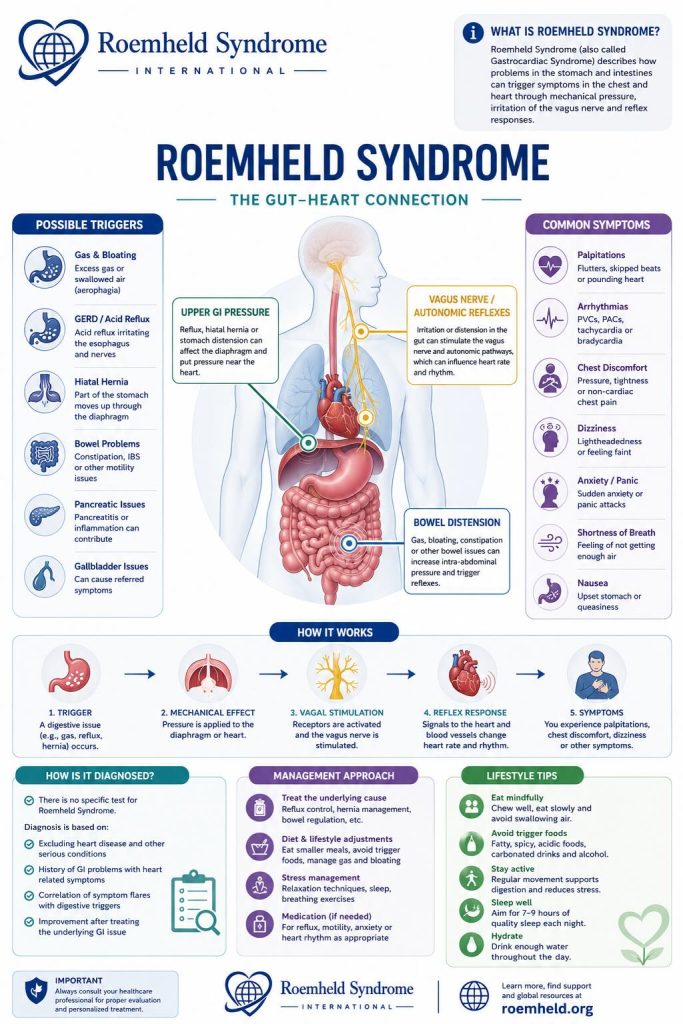
Roemheld syndrome, also known as Gastro-Cardiac Syndrome, isn’t a standalone differential diagnosis (yet), but a label for a specific combination of gut‑driven symptoms (bloating, gas, reflux) and heart‑related sensations such as palpitations, chest discomfort or extra beats (PVC’s). Early medical writers, including Ludwig Roemheld himself (in 1912!), described the phenomenon in patients with gastrointestinal disorders, but modern epidemiological data are almost non‑existent, and there are no large‑scale studies. Nearly all recent literature consists of individual case reports and small observational studies. Consequently, the syndrome remains neglected and underdiagnosed in the evaluation of arrhythmias. Our foundation aims to bring together these scattered insights so that patients and healthcare professionals can better understand this under‑recognised phenomenon
Many social-media groups, online articles and videos about Roemheld syndrome attract thousands of comments from people who are relieved to see their own mix of digestive and heart symptoms described. Such anecdotal stories aren’t scientific evidence on their own. However, when these personal reports are so numerous—and at the same time the medical literature notes that gastro‑cardiac syndrome remains a neglected and underdiagnosed factor in the work‑up of arrhythmias and that there are no reliable prevalence data because only sparse case reports exist: it suggests a potential unmet clinical need. This community deserves to be listened to and the condition warrants more systematic research and clinical awareness.
All that’s left is for the patients is to convince their doctor, and to find a cure. That’s the hard part.
Possible Symptoms
While most people think of heart-related symptoms, there are actually three different ares we should examine: Gastrointestinal, Cardiovascular and Psychological. Patient can have one or more symptoms in each category
Possible Gastrointestinal Causes
The Roemheld Syndrome is thought to be a combination of mechanical, neurological, hormonal, and immunological variables that influence the heart’s rhythm and function.Based on the article: Exploring Roemheld syndrome: a comprehensive review with proposed diagnostic criteriaHerz Magazine, 7 May 2024Authors: Muhammad Umair Javaid, Muhammad Ikrama, Shafqat Abbas, Muhammad Saad Javaid, Muhammad Danial Khalid, Nabeel Riaz, Malik Ahsan Safdar. https://doi.org/10.1007/s00059-024-05249-yWe'd like to thank the authors for allowing us to cite from the article.
Possible Treatments
The word “possible” is used deliberately. There is currently no single treatment that works for everyone with suspected Roemheld Syndrome.
Many people experience significant symptoms that can greatly affect their quality of life. It is understandable that patients are searching for answers and effective treatments. However, Roemheld Syndrome appears to have multiple possible causes and triggers, meaning that what works well for one person may have little or no effect for another.
The treatments listed below have been reported by patients, physicians, and researchers. Experiences vary widely. Some patients describe a treatment as ineffective, while others report dramatic improvement or even complete resolution of their symptoms.
Finding the right treatment often requires patience, careful observation, and close collaboration with a healthcare professional. The goal of this section is not to recommend a specific treatment, but to provide an overview of options that have been discussed in the medical literature or reported by patients living with Roemheld Syndrome.
Diagnosis
Important: Roemheld Syndrome Is Not an Official Diagnosis
Roemheld Syndrome (also known as Gastrocardiac Syndrome) is currently not recognized as a formal medical diagnosis in major classification systems such as ICD-11 or DSM-5.
Many physicians may therefore be unfamiliar with the term. Patients are often diagnosed with the individual conditions that may contribute to their symptoms, such as gastroesophageal reflux disease (GERD), hiatal hernia, gastritis, bloating, arrhythmias, anxiety, or other gastrointestinal and cardiac disorders.
For this reason, Roemheld Syndrome is generally considered a diagnosis of exclusion.
What Does “Diagnosis of Exclusion” Mean?
A diagnosis of exclusion means that potentially serious medical conditions should be investigated and ruled out before considering the possibility of Roemheld Syndrome.
Chest pain, palpitations, shortness of breath, dizziness, fainting, or irregular heartbeats should always be evaluated by a qualified healthcare professional.
Cardiac Tests Commonly Performed
Depending on the symptoms, physicians may perform one or more of the following tests:
- Electrocardiogram (ECG / EKG)
- Holter monitor (24–72 hour ECG monitoring)
- Event recorder or extended rhythm monitoring
- Exercise stress test
- Echocardiogram (heart ultrasound)
- Blood tests (including cardiac enzymes)
- Coronary CT angiography
- Cardiac MRI
- Electrophysiology studies (in selected cases)
These tests help identify or exclude underlying heart disease and cardiac rhythm disorders.
Gastrointestinal Tests Commonly Performed
Because many patients report digestive symptoms, physicians may also investigate the gastrointestinal tract.
Possible tests include:
- Upper endoscopy (gastroscopy)
- Esophageal pH monitoring
- Esophageal manometry
- Barium swallow study
- Abdominal ultrasound
- CT scan
- Gastric emptying studies
- Evaluation for hiatal hernia
- Testing for Helicobacter pylori infection
Not every patient requires every test.
Proposed Diagnostic Criteria
In 2024, researchers published a review article proposing diagnostic criteria for Roemheld Syndrome. These criteria have not been formally validated but represent one of the first attempts to create a structured diagnostic framework.
The proposed criteria include:
- Gastrointestinal symptoms
- Cardiac symptoms
- A temporal relationship between the two
- Exclusion of alternative explanations
- Improvement after treatment of the gastrointestinal condition
Further research is needed before these criteria can be considered established.
Could I Have Roemheld Syndrome?
No online article can diagnose Roemheld Syndrome.
However, the possibility may be worth discussing with your healthcare provider if:
✓ Cardiac symptoms consistently occur after eating or during periods of digestive discomfort
✓ Symptoms worsen with bloating, reflux, gastric distension, or abdominal pressure
✓ There appears to be a clear temporal relationship between digestive symptoms and cardiac symptoms
✓ Cardiac investigations are largely normal or do not fully explain the symptoms
✓ Treatment of an underlying gastrointestinal condition leads to improvement in cardiac symptoms
✓ Other potential cardiac, gastrointestinal, or medical causes have been appropriately evaluated
Editor’s Note
One of the greatest challenges surrounding Roemheld Syndrome is that there is currently no single test that can confirm or exclude the condition.
As a result, patients often undergo extensive cardiac and gastrointestinal investigations before a possible connection between the two systems is considered.
While modern research has renewed interest in the concept of Gastrocardiac Syndrome, much remains unknown. Patients should be cautious of anyone claiming to diagnose Roemheld Syndrome using a single test, supplement protocol, microbiome analysis, or alternative therapy. At present, careful medical evaluation and exclusion of other conditions remain the foundation of diagnosis.